Basic Information






Secondary Structure
Secondary Structure
Secondary structure that contributes a minimum of free energy.
Thermodynamic properties of the Boltzmann ensemble.
Structure Prediction
Transcripts
| ID | Sequence | Length | GC Content |
|---|---|---|---|
| NM_001354571.2 | CUACCUUUCCCAGCAGAGCACCUGGGUUGGUCCCGAAGCCUCCAACCAC… | 1577 nt | 0.5460 |
| NM_001354572.2 | CUACCUUUCCCAGCAGAGCACCUGGGUUGGUCCCGAAGCCUCCAACCAC… | 1571 nt | 0.5455 |
| NM_001354573.2 | CUACCUUUCCCAGCAGAGCACCUGGGUUGGUCCCGAAGCCUCCAACCAC… | 1490 nt | 0.5483 |
| NM_001622.4 | CUACCUUUCCCAGCAGAGCACCUGGGUUGGUCCCGAAGCCUCCAACCAC… | 1574 nt | 0.5457 |
Summary
The protein encoded by this gene is a negatively-charged serum glycoprotein that is synthesized by hepatocytes. The encoded protein consists of two polypeptide chains, which are both cleaved from a proprotein encoded from a single mRNA. It is involved in several processes, including endocytosis, brain development, and the formation of bone tissue. Defects in this gene are a cause of susceptibility to leanness. [provided by RefSeq, Aug 2017]
Forensic Context
AHSG is a validated mRNA marker specifically associated with liver tissue identification. It was identified as part of a panel of biomarkers (including AHSG, AMBP, and VTN) used to detect liver tissue in post-mortem samples through multiplex RNA analysis . The assay demonstrated high specificity, correctly identifying liver tissue in individual samples without cross-reactivity with other organ tissues. Additionally, the method showed robust sensitivity, reliably detecting liver tissue even in highly diluted lysates (1:10,000 dilutions, corresponding to 2 ug of tissue) and in complex mixtures containing up to four components
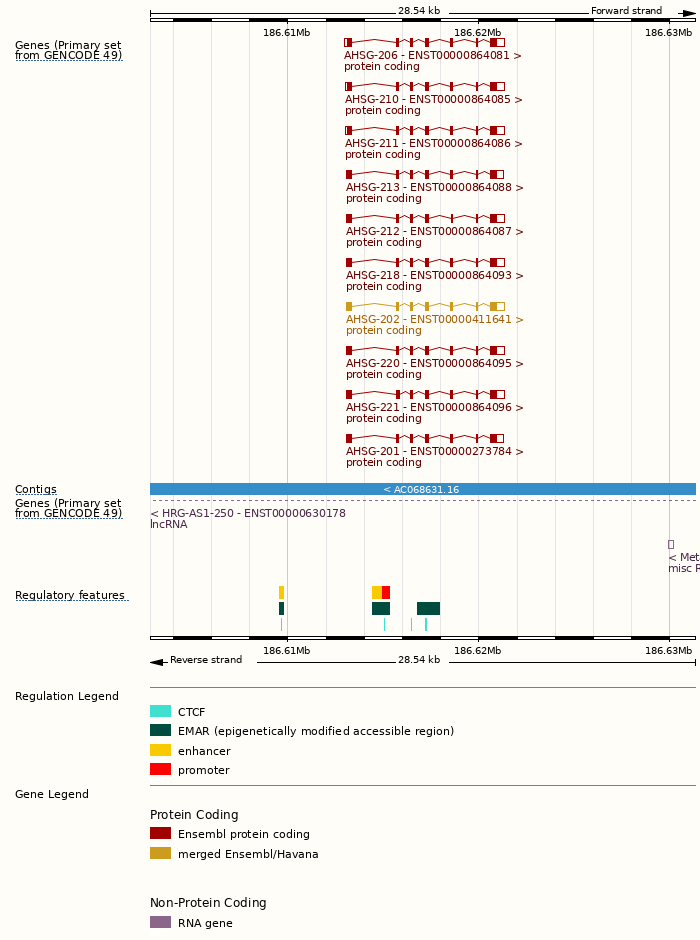
Genomic Tracks